Sotheby’s bets on New York demand for Indigenous art
Australian Indigenous art will once more feature in New York’s glamour spring auction calendar this month, after a hiatus forced by the boating death of pioneering Sydney art consultant Tim Klingender.
Klingender’s tragic death off Sydney Heads in 2023, when he had just returned from leading Sotheby’s last successful auction of Indigenous art in New York, caused Sotheby’s to shelve the 2024 edition for which Klingender was the kingpin and driver.
At the time of his death Klingender was Senior Consultant, Australian Art to Sotheby’s internationally. In that capacity, he had arranged Sotheby’s Aboriginal art auctions in London from 2015 to 2018, and from 2019 in New York.
This May 20 edition of its Aboriginal Art auction is still working with Tim Klingender Fine Art, now led by the consultant’s widow Skye McCardle Klingender.
But many of the hard yards of pulling the auction together were done by Wally Caruana, head curator of Indigenous art at the National Gallery of Australia from 1984 to 2001, and Geoff Cassidy who worked alongside Klingender when both men were employed by Sotheby’s in Sydney 25 years ago.
Cassidy is a former director of Artbank, the Federal Government collecting and art-leasing initiative, and is on the board of the Sydney Biennale, and told Saleroom that preparing the exhibition had been a “huge” undertaking which involved “getting inside Tim’s head”.
This was easier for Cassidy than for many others, since he and Klingender were close friends.
Klingender fostered impeccable contacts among owners and collectors of fine Indigenous art around the world, and Cassidy said many of these enthusiasts expressed delight about the reintroduction of the annual sale.
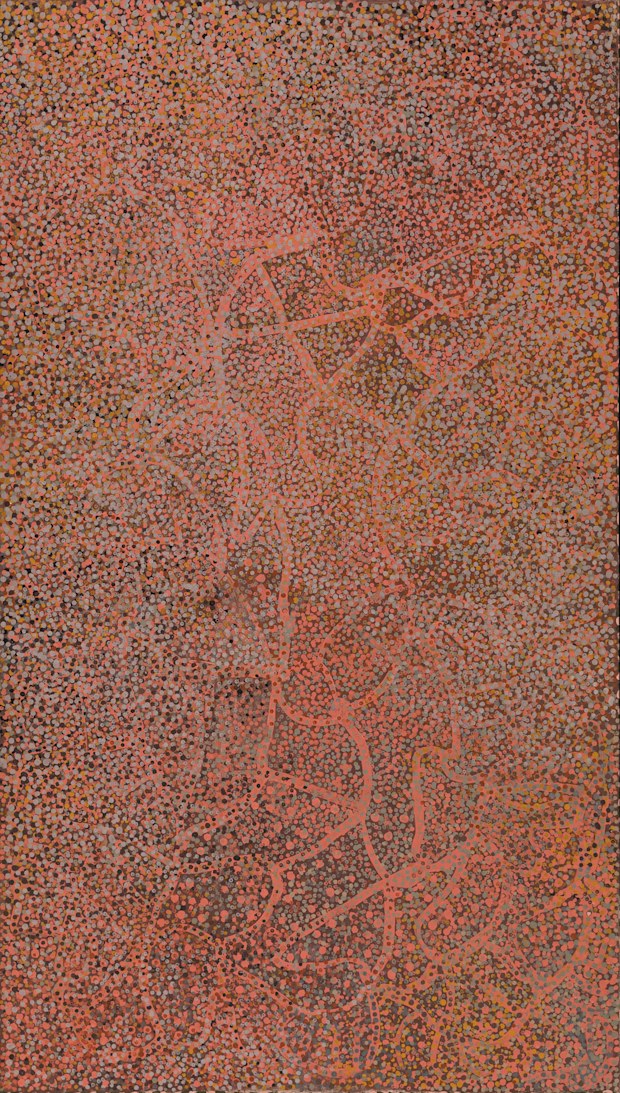
The catalogue features 67 artworks (that number may change slightly towards the end of this week), headlined by a large painting by the late Emily Kame Kngwarreye that could sell for seven times the price the owner paid in 2011.
The Kngwarreye, Untitled, 1990, measures 213 x 122 cm and was featured in the artist’s major survey exhibition at the National Gallery of Australia from December 2023 until April 2024. (The exhibition’s title, Emily Kam Kngwarray, reflects the varying spellings applied to some Indigenous artists’ names.)
Untitled was sold to the current owner for $102,500 (including buyer’s premium of 25 per cent) through Deutscher + Hackett auctioneers in Melbourne in 2011.
The work’s estimate in the Sotheby’s catalogue is $US500,000 ($770,000) to $US700,000, reflecting Kngwarreye’s meteoric market trajectory over the last 15 years.
According to the Sotheby’s catalogue, Untitled was painted just over a year after Kngwarreye took up synthetic paints and canvas, and attests to the artist’s decades-long experience of drawing in the sand.
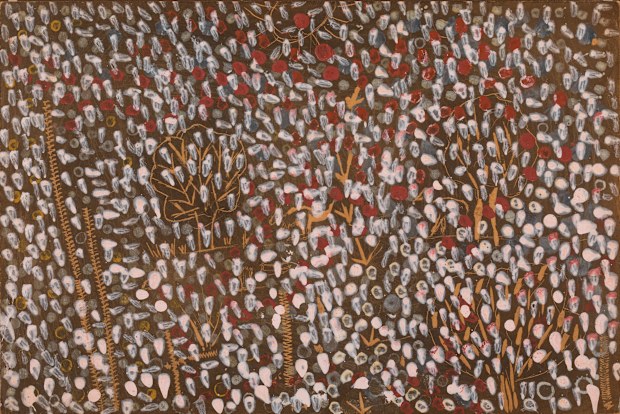
The work depicts the meandering roots of the pencil yam and flurries of dotting that refer to its seeds. It also refers to the male emu shepherding his chicks to feed on the vine and its seeds.
Two smaller, far less pricey works by Kngwarreye are described in the Sotheby’s catalogue as “among the most intimate pictures” she ever created. In both paintings, Sotheby’s asserts, Kngwarreye was deliberately emphasising her individuality as a senior woman among her Anmatyerr people at Utopia, a remote desert area 250 kilometres north-east of Alice Springs.
Kngwarreye took part enthusiastically in some of the art workshops introduced to the Indigenous people there, and mastered batik and painting on canvas.
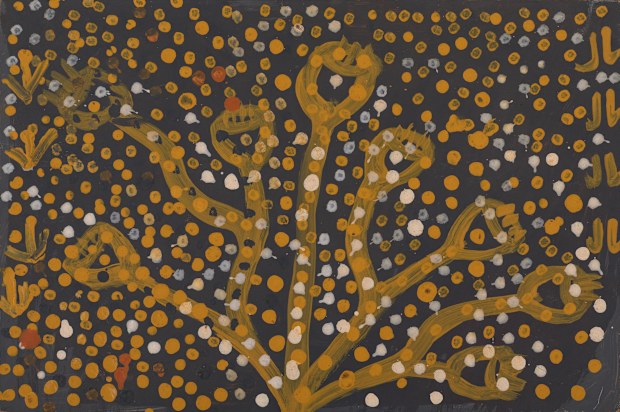
But she declined to take part in a 1990 woodcut print project. Instead, she took two boards intended for the project and painted on them instead. One of the boards was already carved by another artist, (possibly her closest companion, Lily Sandover Kngwarreye). The other board was uncarved.
Both paintings depict the yam plant, “the very essence of Kngwarreye’s identity”, the catalogue states. The works are Untitled [with carving], 1990, and Untitled [Kame], 1990, both on boards measuring 30 x 45 cm and each carrying an estimate of $US30,000 to $US50,000.
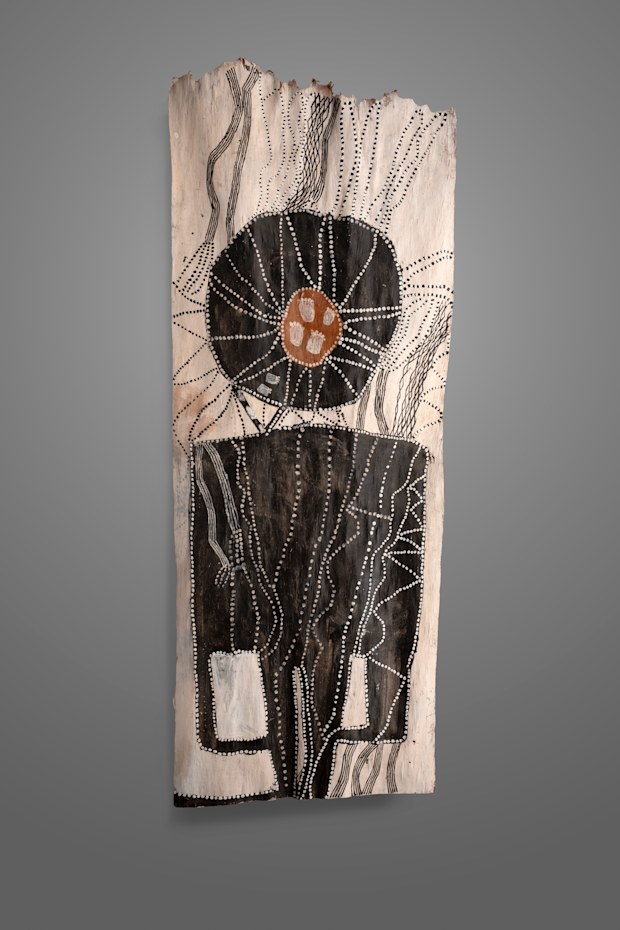
Another highlight in the Sotheby’s auction is a work from the collection of Tim Klingender himself.
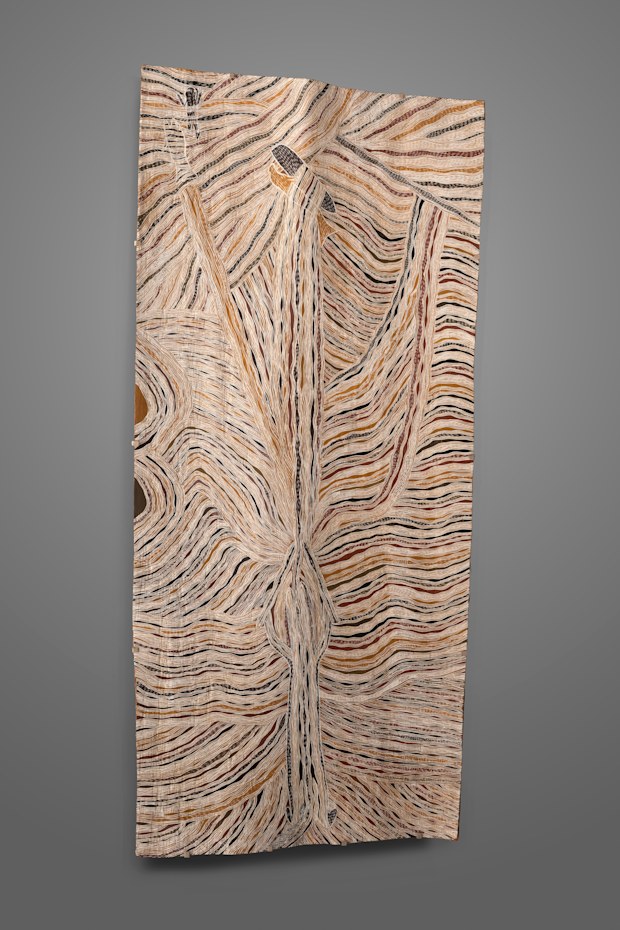
The piece is Nonggirrnga Marawili’s painting on bark, Baratjala, 2020, which carries a pre-sale estimate of $US80,000 to $US120,000. The work depicts “the tempestuous nature of the eastern coast of Arnhem Land at the height of the monsoon season”, the catalogue states.
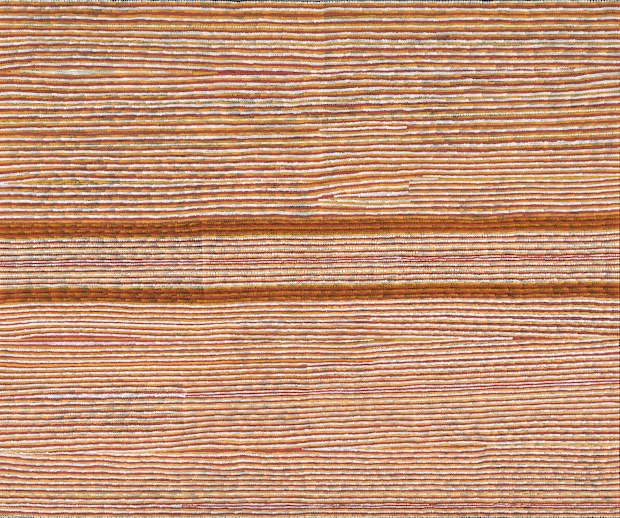
Baratjala is an important site for Marawili’s Madarrpa clan on the east coast of Arnhem Land at Cape Shield.
Turkey Tolson Tjupurrula is represented in the catalogue with a painting almost two metres wide that evokes warriors straightening spears over a fire near present-day Kintore.
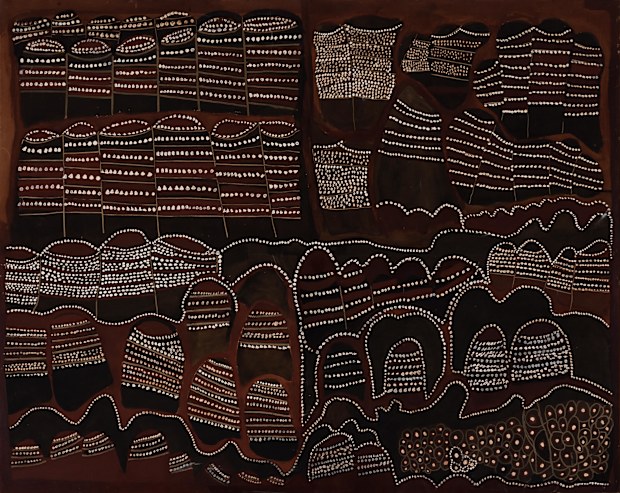
Straightening the Spears (Ilyingaungau) features closely-ranked horizontal lines to depict the spears themselves. Art historian Vivien Johnson also suggests the artist may have been depicting an unusual vertical rock formation at Ilyingaungau. Tjupurrula was a Pintupi artist who died in 2001.
Other works of note in the Sotheby’s catalogue include Purnululu, The Bungles, 1989, by Jack Britten. Painted in acrylic and natural earth pigments on canvas, it measures 160 x 200 cm and is estimated at $US50,000 to $US80,000.
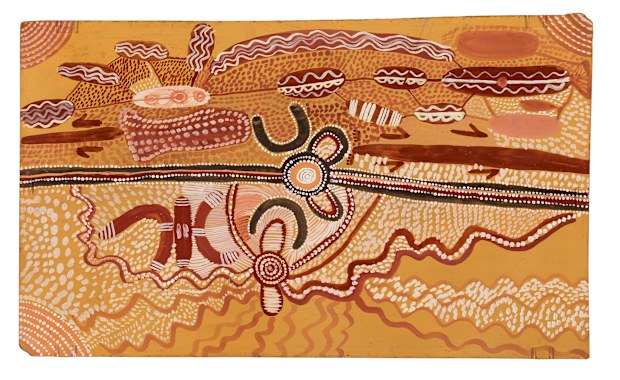
Timmy Payungka Tjapangarti’s Untitled (Ceremony), 1972, has been held in a private collection at Cooma, NSW, since the 1980s. Its estimate is $US60,000 to $US80,000.
Djambawa Marawili’s Metamorphosis/Yathikpa, 2006, in natural earth pigments on a sheet of bark more than two metres long, is estimated at USD 20,000 to 30,000.
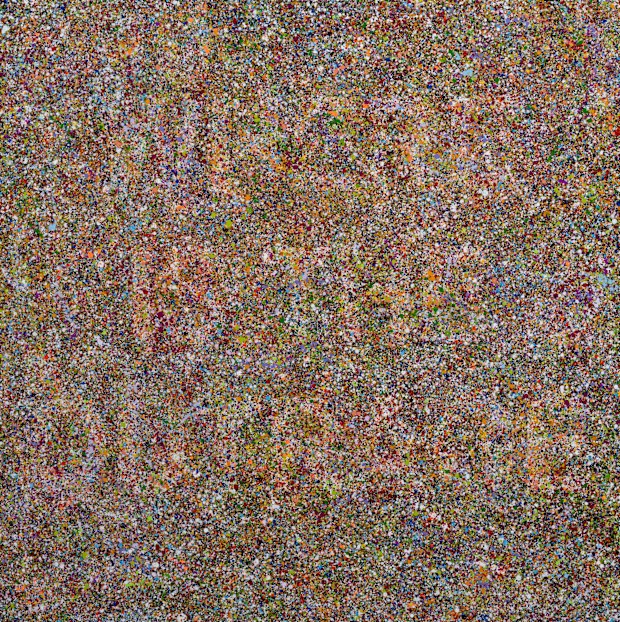
Among overtly contemporary artworks in the auction are two paintings by Richard Bell, the self-confessed Queensland rabble rouser whose works are laced with wit and irony.
In the painting, Where is the outrage, 180 x 180 cm, from a private Brisbane collection, Bell employs dots in the manner of many Indigenous artists from the desert. But Bell declared that “traditional” dotting was a form of slave labour demanded by the white-controlled art market. He named the technique “desperately seeking Emily”, in homage to Emily Kame Kngwarreye.
The text “Where is the outrage” is barely discernible within the veils of dotting and refers to the ongoing and often invisible struggle of Indigenous Australians.
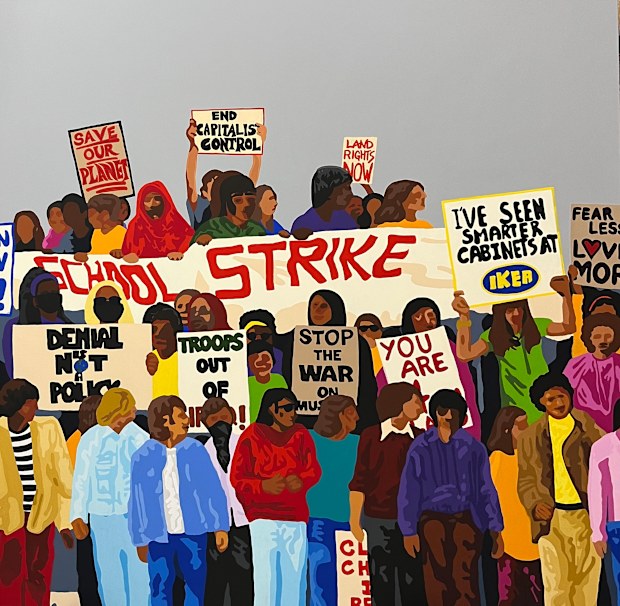
Bell’s painting Strike, 2022, the same size and estimate as the foregoing painting, is a protest piece that featured on the cover of the publication for Bell’s installation, Embassy, at Tate Modern in London in 2023, his dealer Josh Milani told Saleroom.
Sotheby’s Aboriginal Art auction will be held live in the firm’s Manhattan premises at 4pm on May 20, New York time.
With lots still being finalised, all Cassidy could confidently reveal about estimates totals was that the lower end is around $US3 million ($4.63 million).
This month in New York, the world’s auction houses will offer numerous pieces of art in the tens of millions of dollars each. But with recent art market reports noting a slackening of interest in the highest-priced works, and more focus on the lower end, perhaps the conditions will favour the Aboriginal Art auction.
Turning to local news, Leonard Joel’s Monday evening Centum sale (focusing on contemporary art) saw sales totalling $795,886. This was 70 per cent sold by value and 66 per cent by number.
The highest price went to a Ben Quilty painting, Jm, Humanist, chairwoman and Rockstar … keeper of Clarkey, a portrait of singer Jenny Morris which fetched $61,364 including buyer’s premium.
Adam Cullen’s Perdition 1 (Ned Kelly), 2011, also sold well. It fetched $31,909 against an estimate of $5000 to $7000 and placed the bushranger’s armoured head against a candy-pink backdrop.
Share