Foreign buyers swoop as Indigenous art takes off
The late, great Emily Kam Kngwarreye was the prime mover behind the most financially successful Indigenous art auction in this country since 2007, with a much-travelled work once owned by a leading corporate identity becoming the artist’s second most expensive painting under the hammer.
Kngwarreye’s Untitled (Awelye), 1992, soared away from its pre-sale estimate of $400,000 to $600,000 to fetch $1,196,591 including 25 per cent buyer’s premium in Deutscher + Hackett’s auction of Important Australian Indigenous Art in Melbourne on March 26.
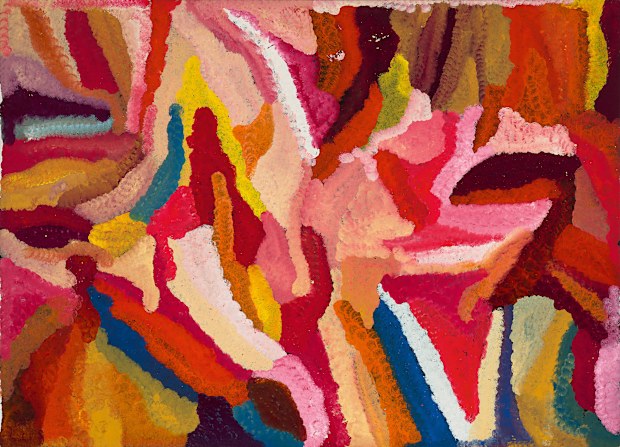
The only other Kngwarreye painting to sell for a higher price at auction is the mighty, six-metre-long Earth’s Creation 1, 1994, which fetched $2.1 million at an Art Leven auction in Sydney in 2017.
Kngwarreye’s Untitled (Awelye) was originally owned by lawyer Hugh Jamieson, who was chairman of Allens Arthur Robinson until 1994 and who was renowned for shaping that firm’s corporate art collection.
Last week’s auction was the third time Deutscher + Hackett had handled the 164 cm x 228 cm painting. In 2011 it sold for $204,000 and in 2013 it fetched $168,000.
The massive jump in price last week shows the meteoric trajectory of Kngwarreye’s art, which is appreciated all over the world. For example, a major exhibition celebrating the Anmatyerr artist’s life and work will be on view at London’s prestigious Tate Modern gallery from July 10 this year until January 11, 2026.
Overall, Deutscher + Hackett’s Indigenous art auction recorded total sales of $4,222,309 (including buyer’s premium). The auction house’s equivalent auction held last year yielded total sales of $2,358,204.
Heavy lifting done by Kngwarreye, and 10 new artist auction records that were set on the night, raised the overall sales results, D+H head of Indigenous art Crispin Gutteridge told Saleroom.
The sale’s clearance rates were 144 per cent by value and 80 per cent by volume. Of the 60 lots that sold, a quarter were snapped up by buyers in the US, the UK and Europe, and Gutteridge said international demand for Australian Indigenous art was clear.
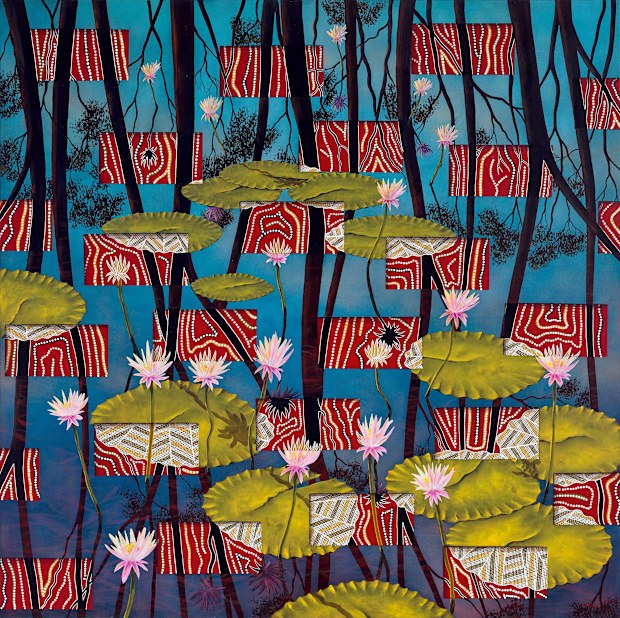
The other big earners in last week’s auction included Arafura Swamp IV, 1996, by Lin Onus. It sold for $368,182 against an estimate of $300,000 to $400,000.
Next was Albert Namatjira’s watercolour on paper, Arafura Sea at Darwin, 1950, which sold for $233,182 against a far lower estimate of $60,000 to $80,000.
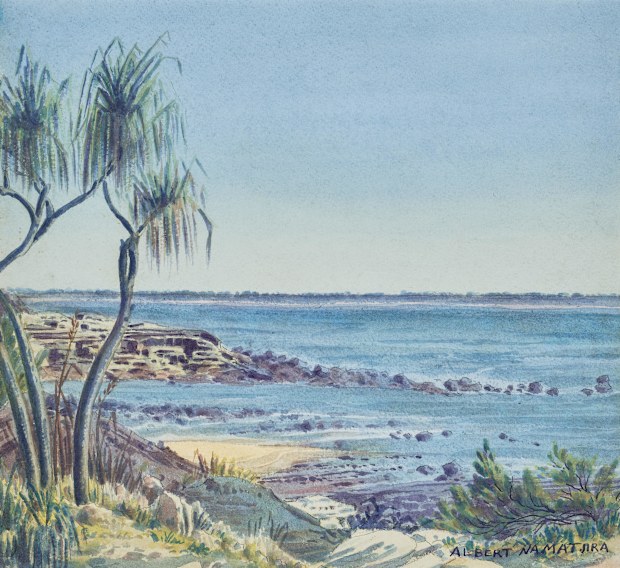
Originally purchased from Anthony Hordern’s Fine Art Gallery in Sydney in 1952, Arafura Sea at Darwin has been in a private collection in Melbourne since 1984.
According to Gutteridge, the work sailed way beyond its estimate because of its rarity. It’s one of only four or five seascapes ever attempted by Namatjira. The occasion to do so arose when the artist left his desert home for Darwin in a failed attempt to gain permission to buy some grazing land on which to establish a commercial enterprise.
The disappointment was one of many for Namatjira, whose remarkable life story is well known and documented.
The fourth-highest price was Untitled, 2007, by Doreen Reid Nakamarra. It sold for $208,636 against a pre-sale estimate of just $30,000 to $40,000, setting an auction price record for the Pintupi and Ngaatjatjarra artist.
Prospective bidders at the auction viewings in Sydney and Melbourne had gazed at Nakamarra’s mesmerising work in which seemingly endless sandhills seem to shimmer and shift, Gutteridge said.
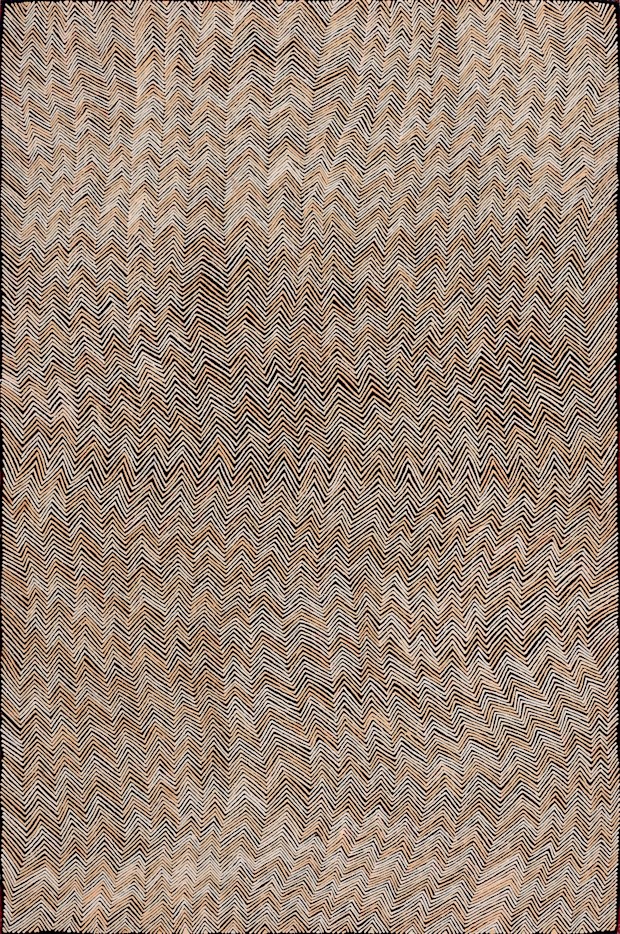
Measuring 182 cm x 120.5 cm, Untitled certainly exerts an authoritative presence.
The high price it achieved is because of the relative scarcity of Nakamarra’s works on the auction market, and because of the painting’s relationship to a similar work by Nakamarra at Queensland Art Gallery | Gallery of Modern Art in Brisbane.
The work at QAGOMA, Untitled (Marrapinti), 2008, is displayed lying flat so visitors can best appreciate its optical effect. According to QAGOMA’s Facebook page, many of the gallery’s volunteer guides have voted the Nakamarra painting as their favourite work in the collection.
Getting back to the Namatjira family, Albert’s great grandson Vincent Namatjira is achieving enormous success with his portrait-based paintings which combine larrikin humour with a poke at the rich and powerful.
The two Vincent Namatjira’s in the Deutscher + Hackett auction included The Queen and Me, 2017, in which the late Queen Elizabeth II and Namatjira stand shyly shoulder to shoulder.
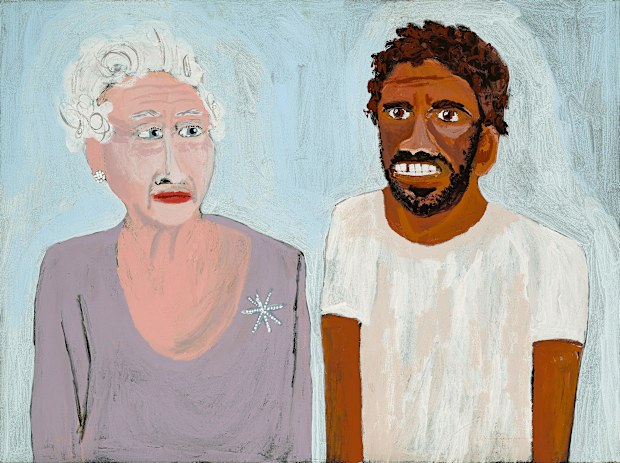
The young artist has the knack of capturing his subject’s characteristics, Gutteridge said.
“The Queen is part of his exploration of colonialism and power and money from where he sits in his community, so they’re very expressive works,” he said. The work sold for $36,818 on an estimate of $30,000 to $40,000.
Among other contemporary works by Indigenous artists, there were mixed results.
For instance, Christian Thompson’s striking photographic self-portrait, Rocks on your belly, 2013, in which the artist shows his face festooned in feathers, was estimated at $10,000 to $15,000 but failed to sell.
But Danie Mellor’s work in mixed media on paper, titled A Western spectacle, 2008, fetched a handsome $49,091 against a pre-sale estimate of $20,000 to $30,000. A Western spectacle superimposes a koala and its joey against a pattern you might find on your grandmother’s teacups.
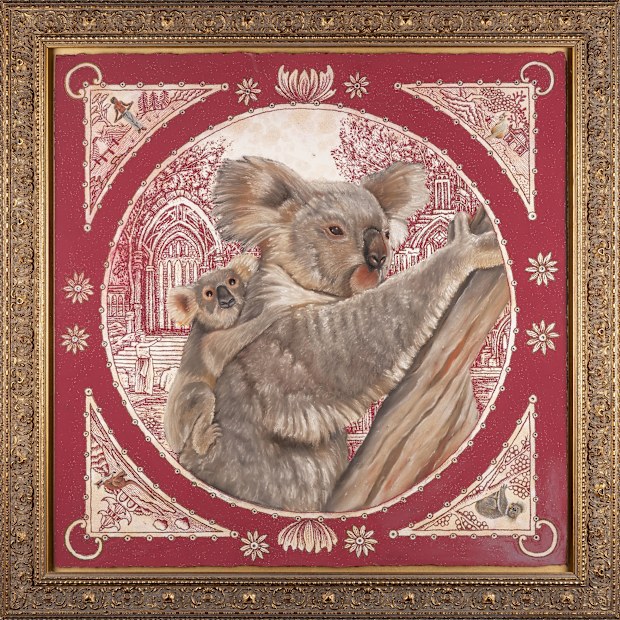
Mellor is a “cultural investigator” who draws from both his Western and Indigenous origins, according to the essay accompanying the artist’s 2008 exhibition at the Holmes à Court Gallery in Perth.
“He investigates the narrative of Australian history and analyses and emphasises the complex interactions between the two cultures,” the essay states.
“This is achieved through the strong use of collective imagery; maps, boomerangs, shields, dilly bags and kangaroos to patterned china, historical botanical references and kitsch Australiana. At once a celebration of Australia’s collective history and a reminder of the displacement and separation circumscribed within it.”
Six paintings from Indigenous art centres in the APY Lands were featured in the auction. They were among the first to be offered at auction since 2023 when The Australian newspaper aired a video which seemingly showed white assistants adding paint to an Indigenous artist’s canvas.
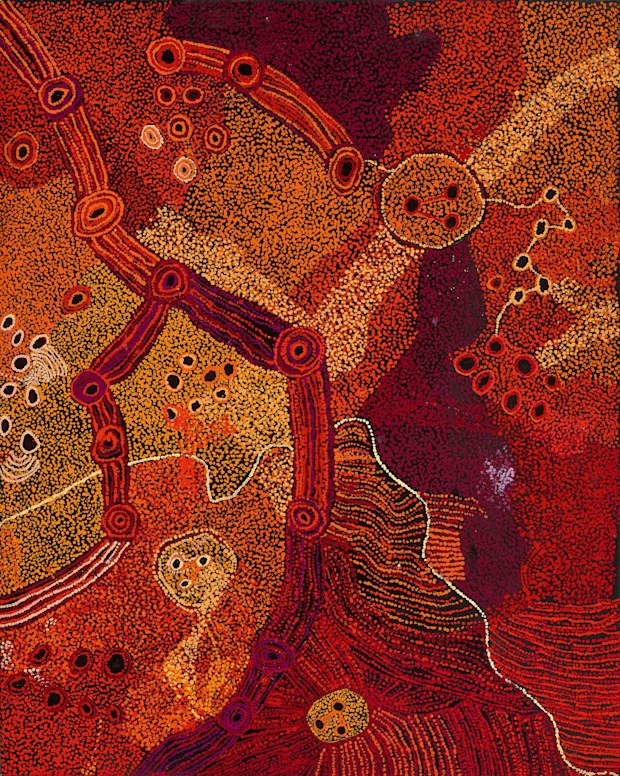
A number of consequent investigations into the APY Arts Centre Collective have been concluded with no further action to be taken.
A work by APY Lands artist Wawiriya Burton, titled Ngayuku Ngura – My Country, 2018, went unsold (estimate $12,000 to $15,000). But Betty Muffler‘s Ngangkari Nugura (Healing Country), 2016, fetched $19,636; Peter Mungkuri‘s Ngura (Country), 2018, fetched $9818; Betty Chimney‘s Ngayuku Ngura (My Country), 2022, fetched $11,659, and Sylvia Kanytjupai Ken’s Ngayuku Ngura (My Country), 2012, fetched $12,273. Most prices were within or above the estimate.
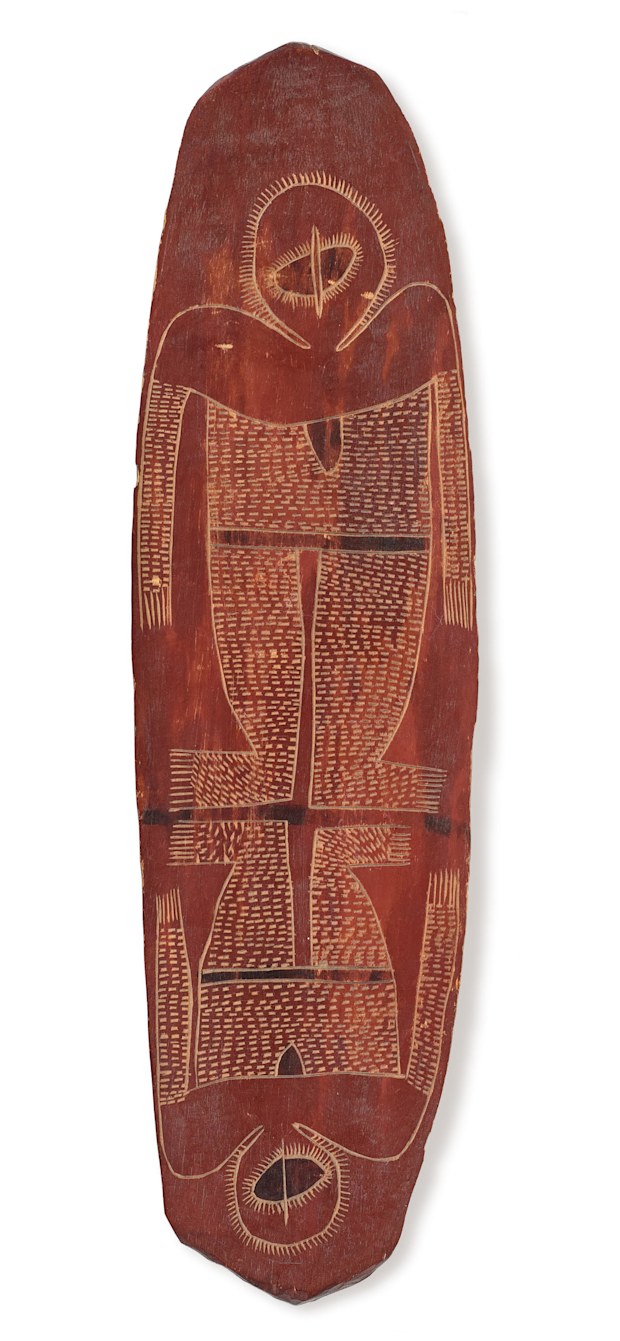
Elsewhere in the sale, Alec Mingelmanganu’s carved and engraved wood with natural earth pigments, Double Wanjina, c.1978, featured in Saleroom several weeks ago, sold for $13,500.
The small but powerful carving was picked up for a song in an estate auction in Canada and sent back to Australia for sale. According to Gutteridge, the clever person who spotted the work in the estate jumble sale will donate part of the sale proceeds to an Indigenous cause.
Share